A long-aged question that many people commonly ask is which bench press variation works the best. Well, one way to define this is by comparing the muscle activation between each type of bench press and grip styles. You might say that picking the movement with the most activation is best, this could be true in some cases, but it can also increase risk of injury.
Today I will be reviewing “Electromyographic Activity of the Pectoralis Major Muscle during Traditional Bench Press and Other Variants of Pectoral Exercises” written by Lopez-vivancos et al… Hang in there for a second long, I know that was a long exhausting title, but all it means is the muscle used during the bench press movements are being monitored for force produced from said muscle group in different types of the same exercise.
Bench press is one of the most important lifts to master; it can be quite relevant to you by figuring out the best variant to use. More progress can be made from this exercise selection choice and less injury risk.
Sounds pretty good right!
Let’s dive right into the paper’s specifics. The who, and what? This paper first searched across three databases of other research literature and gathered at total of 1938 samples. That was narrowed down to 23 for the final meta-analysis. A flow chart below accurately depicts what required exclusion of sample papers.
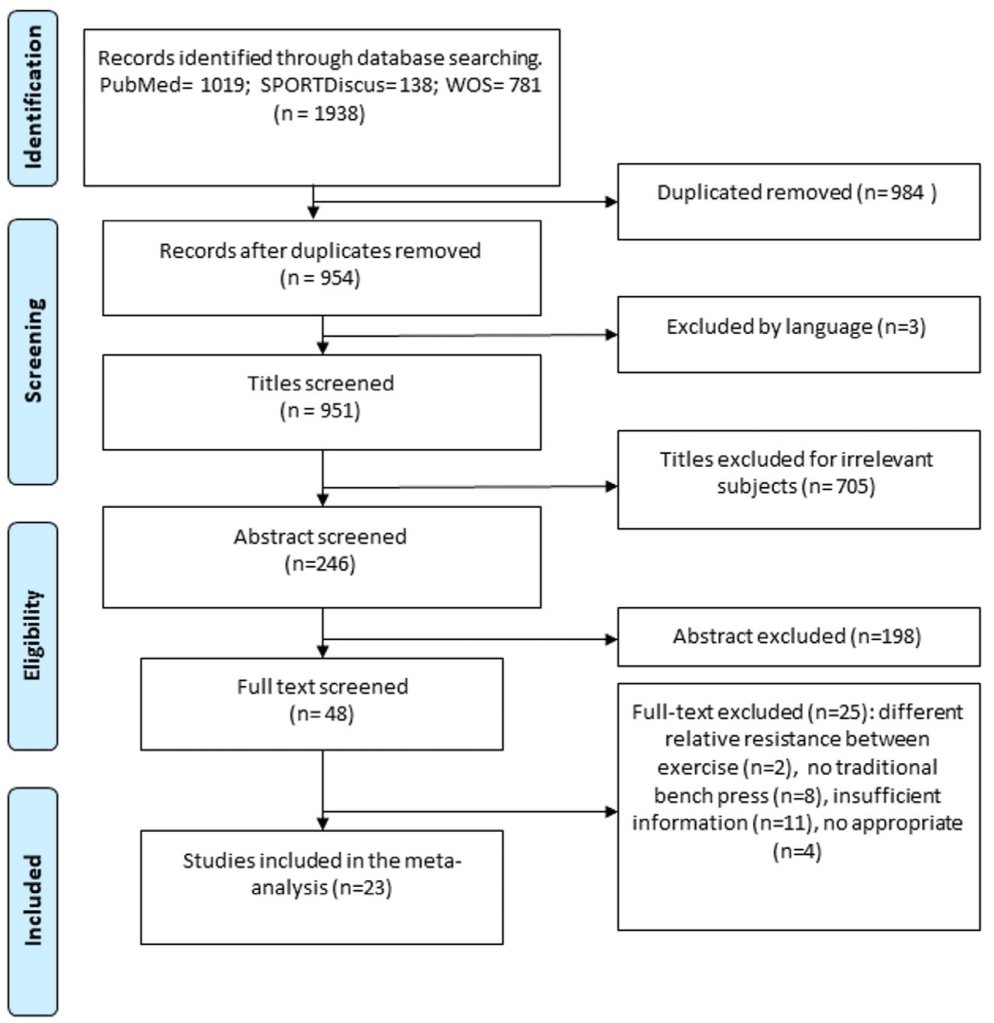
These studies included the following variations bench tilt, grip, and less stable bench movements with dumbbells.
One method of collecting data points was the electromyographic activation, which is the muscle contractions. The data points show an inconclusive right or wrong exercise for muscle activation when compared across the board. It’s more of a point comparing apples to oranges, just being similar enough to not produce enough of a different to make a conclusion.
However, they did find significant data in the angles of the bench presses. Having a wide grip stance, created more muscle contractions (EMG) for the middle chest activation but also put more strain on the shoulder joints. Whereas the narrow grip bench reduced the injury risk but significantly reduced the muscle contraction of the middle chest. Which indicates that the grip impacts chest activation and injury risk.
“These factors may indicate the proper grip type to generate sufficient muscle activation to obtain hypertrophy, increase muscle strength, and prevent injuries”.
The researchers are saying this is an important choice because of the implication towards potential muscle growth and reducing injury risk!
Bench tilt showed significant difference in where the activation occurs. A tilt adjusted up on the bench creates more contraction force towards the upper chest, and conversely with a declined bench tilt with the lower to middle chest activation is higher.
Instability movements are exercises that are performed with free weights and unattached to machines as a form of resistance training. Dumbbells are a common example of this.
The studies looked into dumbbell chest press and found significant data. Showing an increase in chest activation and a potential for increased range of motion in the movement. The range of motion in the movement is how far the muscle can be stretched, a traditional bench press with a bar is restricted by the bar hitting the chest and no more range of motion can be generated. Whereas the dumbbells are not restricted in this way, just by individual differences in shoulder mobility and injury risk mitigation. It was also found to increase different neuromuscular adaptations, which is your muscle memory for different movements. This could be more functional to daily life movements.
What can be concluded from this mess of words??
Well, it indicates that grip, tilt of the bench and instability all matter. How you use this data is understanding your goals. If this is the goal, then I do that to achieve it. Let me give an example of this.
A female client, 27, with no shoulder injuries, athlete, wants a bigger upper chest and is unsure of what exercise to choose.
My immediate thoughts, prior training check, injury history clear, upper chest equals a tilted bench and narrow grip. Additionally, dumbbells help reach more functional movements for an athlete. The prescription of exercise would be a narrow grip angle of the dumbbells on an incline bench for 3 working sets of 8-12 reps. And certainly, this can be a traditional bench if they prefer that exercise more with a barbell. At the end of the day, it matters more to have adherence and happiness with the workout than maximizing it.
Inconclusion, this reaches the proper chest activation, risk mitigation and neuromuscular adaptations necessary to this client.
I hoped this longer read helped some of you out there with a chest exercise selection. Just remember at the end of the day, it’s what works best for you! And having the most fun possible while being safe!
APA citation of the article reviewed, you can copy and paste the link at the bottom of the citation if you want to read the scientific article.
López-Vivancos, A., González-Gálvez, N., Orquín-Castrillón, F. J., Vale, R. G. d. S., & Marcos-Pardo, P. J. (2023). Electromyographic Activity of the Pectoralis Major Muscle during Traditional Bench Press and Other Variants of Pectoral Exercises: A Systematic Review and Meta-Analysis. Applied Sciences, 13(8), 5203. https://doi.org/10.3390/app13085203


Leave a comment